

Sensyte receives CHF 40,000 from Venture Kick to advance real-time airborne threat detection
06.07.2026
Sensyte receives CHF 40,000 from Venture Kick to advance its real-time airborne detection technology for explosives and cocaine. Using a chemoresistive sensor that identifies target molecules directly from ambient air, the startup aims to enable continuous, stand-off detection for applications in airport security, demining, and public safety.
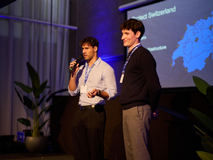 CEO Sebastian Kravecz, CTO Lukas Frabboni
|
 |
What was the first real signal that your solution worked outside the lab or pitch deck, and what did that moment change for you?
Our first real signal wasn’t the technology, it was the problem. Although our solution is still in R&D, every conversation with airport security and demining experts has confirmed the same thing: they immediately recognize the need and are excited about what we’re building.
That gave us confidence that we’re solving a real-world problem. The question is no longer if the need exists, but how quickly we can deliver the solution.
Can you briefly describe your project and where it stood when you entered Venture Kick?
Sensyte is developing a sensor that detects explosives and cocaine in the air in real time, continuously and from a distance. Our chemoresistive technology identifies target molecules directly from ambient air, representing a new approach to detection.
When we entered Venture Kick, our core research was complete, the technology was patented, and the science had been validated in the lab. The next challenge was turning it into a field-ready prototype.
How has the direction of your product/service/product strategy changed since working with the Venture Kick Team?
Venture Kick didn’t change our technical roadmap, but it significantly strengthened our business approach. It encouraged us to engage with investors and potential customers much earlier than we had planned.
Those conversations helped us sharpen our pitch and communicate the value of Sensyte not only to scientists, but also to investors, operators, and decision-makers.
How will the Stage 2 funding help you advance your project concretely?
Stage 2 funding will help us bridge the gap between a lab-proven technology and a field-ready product. We’ll use it to further develop our prototype, identify manufacturing partners for future scalability, and conduct field testing.
It will also allow us to meet customers, investors, and testing partners in person, helping us build relationships and accelerate commercial progress.
Our first real signal wasn’t the technology, it was the problem. Although our solution is still in R&D, every conversation with airport security and demining experts has confirmed the same thing: they immediately recognize the need and are excited about what we’re building.
That gave us confidence that we’re solving a real-world problem. The question is no longer if the need exists, but how quickly we can deliver the solution.
Can you briefly describe your project and where it stood when you entered Venture Kick?
Sensyte is developing a sensor that detects explosives and cocaine in the air in real time, continuously and from a distance. Our chemoresistive technology identifies target molecules directly from ambient air, representing a new approach to detection.
When we entered Venture Kick, our core research was complete, the technology was patented, and the science had been validated in the lab. The next challenge was turning it into a field-ready prototype.
How has the direction of your product/service/product strategy changed since working with the Venture Kick Team?
Venture Kick didn’t change our technical roadmap, but it significantly strengthened our business approach. It encouraged us to engage with investors and potential customers much earlier than we had planned.
Those conversations helped us sharpen our pitch and communicate the value of Sensyte not only to scientists, but also to investors, operators, and decision-makers.
How will the Stage 2 funding help you advance your project concretely?
Stage 2 funding will help us bridge the gap between a lab-proven technology and a field-ready product. We’ll use it to further develop our prototype, identify manufacturing partners for future scalability, and conduct field testing.
It will also allow us to meet customers, investors, and testing partners in person, helping us build relationships and accelerate commercial progress.