


Innunity Therapeutics receives CHF 40,000 from Venture Kick to advance a first-in-class MS therapy
29.01.2026
The biotech startup Innunity Therapeutics has secured Venture Kick support to advance a small-molecule therapy targeting disability progression in multiple sclerosis by addressing chronic innate immune activation not tackled by current treatments. We asked the founders a series of questions about when their solution first proved its value beyond the lab.
 |
 |
What was the first real signal that your solution worked outside the lab or pitch deck, and what did that moment change for you?
The first real signal didn’t come from data, but from a patient day organized by the Swiss MS Society. As the team behind Innunity Therapeutics, we were in a room with people living with multiple sclerosis at every stage of the disease, alongside caregivers and scientists, all actively exchanging ideas.
Can you briefly describe your project and where it stood when you entered Venture Kick?
Innunity Therapeutics is developing a small-molecule therapy to halt disability progression in multiple sclerosis by targeting chronic innate immune activation in the brain.
Most current MS treatments focus on adaptive immunity and relapse reduction, but they don’t address the innate immune processes driving long-term disability. That’s where we come in. When we entered Venture Kick, we had strong academic validation, promising preclinical data, non-dilutive funding, and an interdisciplinary team. What we lacked was a clear, venture-ready positioning, including a sharpened value proposition and a defined clinical development path.
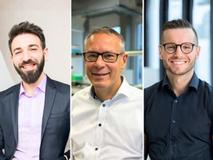
 Innunity Therapeutics Co-Founders: CEO Dr. Antonios Katsoulas, Mentor Prof.Dr. Thorsten Buch, and COO Dr. Barna Gal
How has the direction of your product/service/product strategy changed since working with the Venture Kick Team?
Venture Kick pushed us to simplify in the right way. We moved from a mechanism-driven story to a patient- and market-focused strategy.
With their support, we refined our clinical and regulatory positioning, built a strong Advisory Board, and clarified our development roadmap. We also prepared for investor discussions around IND-enabling activities and fundraising. This marked a clear shift for Innunity, from promising science to a focused, venture-ready clinical plan.
How will the Stage 2 funding help you advance your project concretely?
Stage 2 funding allows us to move forward not just as scientists, but as a company. It enables key validation studies that de-risk the project, including comparative functional studies and early safety work, while helping us finalize our target product profile and non-clinical strategy in line with regulatory expectations.
Beyond the experiments, this funding represents trust. When Venture Kick backs you, it changes your mindset. We’re no longer just exploring an idea, we’re accountable for building something that can reach patients. In early-stage biotech, momentum is fragile, and this support gives us the confidence to keep pushing toward our long-term goal: addressing disability progression in MS.
The first real signal didn’t come from data, but from a patient day organized by the Swiss MS Society. As the team behind Innunity Therapeutics, we were in a room with people living with multiple sclerosis at every stage of the disease, alongside caregivers and scientists, all actively exchanging ideas.
When we presented our preclinical data and showed that we could prevent disability in mice by targeting innate immune signaling, we saw something unexpected: hope. For something not even in the clinic yet, that reaction was powerful. It made us realize our work had started to matter beyond the lab. From that moment on, we stopped thinking only about the science and started focusing on building something durable enough to truly reach patients.
Can you briefly describe your project and where it stood when you entered Venture Kick?
Innunity Therapeutics is developing a small-molecule therapy to halt disability progression in multiple sclerosis by targeting chronic innate immune activation in the brain.
Most current MS treatments focus on adaptive immunity and relapse reduction, but they don’t address the innate immune processes driving long-term disability. That’s where we come in. When we entered Venture Kick, we had strong academic validation, promising preclinical data, non-dilutive funding, and an interdisciplinary team. What we lacked was a clear, venture-ready positioning, including a sharpened value proposition and a defined clinical development path.
Innunity Therapeutics Co-Founders: CEO Dr. Antonios Katsoulas, Mentor Prof.Dr. Thorsten Buch, and COO Dr. Barna GalHow has the direction of your product/service/product strategy changed since working with the Venture Kick Team?
Venture Kick pushed us to simplify in the right way. We moved from a mechanism-driven story to a patient- and market-focused strategy.
With their support, we refined our clinical and regulatory positioning, built a strong Advisory Board, and clarified our development roadmap. We also prepared for investor discussions around IND-enabling activities and fundraising. This marked a clear shift for Innunity, from promising science to a focused, venture-ready clinical plan.
How will the Stage 2 funding help you advance your project concretely?
Stage 2 funding allows us to move forward not just as scientists, but as a company. It enables key validation studies that de-risk the project, including comparative functional studies and early safety work, while helping us finalize our target product profile and non-clinical strategy in line with regulatory expectations.
Beyond the experiments, this funding represents trust. When Venture Kick backs you, it changes your mindset. We’re no longer just exploring an idea, we’re accountable for building something that can reach patients. In early-stage biotech, momentum is fragile, and this support gives us the confidence to keep pushing toward our long-term goal: addressing disability progression in MS.